|
Interview with Professor Michel Théra, University of Limoges, France
--Interviewed by Joydeep Dutta
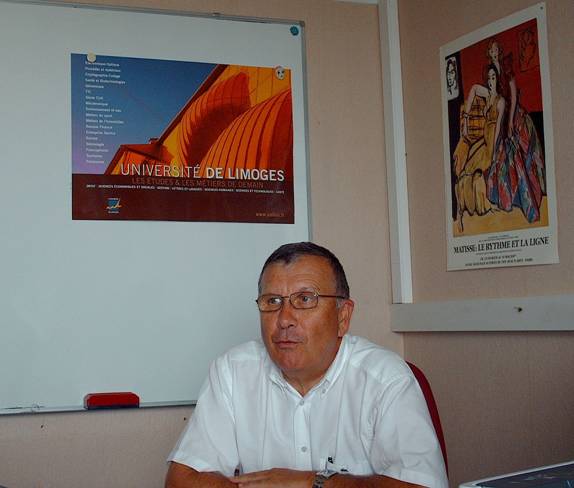
Professor Michel Théra, of the University of Limoges, France is one of the world’s leading experts in nonsmooth analysis and optimization. Currently the Vice-President of the University of Limoges and in charge of International Relations, he is a highly energetic and sympathetic academician. He was the past-President of SMAI (The French Society for Applied and Industrial Mathematics) and before that the head of the optimization group of this society. Apart from being a leading researcher, he has also organized many conferences and workshop in order to popularize optimization in France. He is also widely travelled and equally popular among young and experienced optimizers. Here he is in conversation with Dr. Joydeep Dutta from the Indian Institute of Technology, Kanpur when Dr. Dutta was visiting the University of Limoges during the month of June.
Joydeep Dutta: Were you trained as an analyst or an optimizer?
Michel Théra: I was trained following my masters degree, as an analyst, mostly in Choquet theory, which one would call pure analysis. More precisely, my first work focused on the Silov boundary of a compact space relatively to a family of lower semi-continuous real-valued functions. I also studied the geometry of simplexes and the related Choquet theory. I started my career as an Assistant Professor at the University of Limoges. It was a new university at that time and I spent a lot of time and energy in building up the mathematics department at this University. Thus, in a sense, I started my research quite late in 1976.
Joydeep Dutta: When and how did you get interested in optimization?
Michel Théra: I first got interested in optimization in the year 1976, when I had the opportunity to meet Professor Jean-Paul Penot. He aroused my interest in the subject and we started a joint collaboration and then he finally became my PhD thesis supervisor. I remember that my first project in optimization was to extend the Hormander theorem to the vector setting.
Joydeep Dutta: Was the shift from analysis to optimization difficult?
Michel Théra: Not really, since my training in analysis indeed helped me to progress smoothly with my research in optimization. Further I had carried out a lot of research in functional analysis. Sometimes I do feel that I have indeed worked more in nonlinear functional analysis than in optimization. However, I have applied most of my research in nonlinear analysis to optimization problems.
Joydeep Dutta: You seem to have a broad canvas of research interests. Can you tell us about them?
Michel Théra: I have in fact worked in nonlinear functional analysis and its applications to optimization. In fact I would rather say I have worked mostly in abstract optimization rather than in practical optimization. I am also interested in the geometry of Banach spaces and in variational problems that arise in partial differential equations and unilateral mechanics. This has leaded me to work in the area of non-coercive unilateral mechanics. Further I have also been interested in the study of maximal monotone operators, by my collaboration with Hedy Attouch.
Joydeep Dutta: What was your PhD work?
Michel Théra: During my PhD days I was interested in developing convex analysis for vector functions that of course would have applications to vector optimization problems. I tried to develop the theory of lower-semicontinuous vector vector-valued functions and in particular of lower-semicontinous vector-valued convex functions. I developed a version of the Hahn-Banach theorem for vector-valued functions and also developed subdifferential calculus for vector-valued functions and the theory of Fenchel duality for vector-valued functions.
Joydeep Dutta: Would you consider yourself to be a part of the functional analysis community or the optimization community?
Michel Théra: Of course, I would consider myself to be part of the optimization community, since I have applied results from functional analysis to optimization and thus, at the end, it is the optimizers who know and appreciate the results more than the pure functional analysts.
Joydeep Dutta: Kindly mention three papers which you have enjoyed very much while working on them.
Michel Théra: It is quite difficult to make a list but I would prefer to mention the following three
The first one is an important paper with Hedy Attouch and J. B. Baillon in which we developed using variational tools an extension of the pointwise sum of maximal monotone operators:
Attouch, H.; Baillon, J. -B.; Théra, M. Variational sum of monotone operators. J. Convex Anal. 1 (1994), no. 1, 1--29.
The second one is a continuation of the preceding theory to composite operators with a nice application to elliptic PDES with singular coefficients:
Pennanen, Teemu; Revalski, Julian P.; Théra, Michel Variational composition of a monotone operator and a linear mapping with applications to elliptic PDEs with singular coefficients. J. Funct. Anal. 198 (2003), no. 1, 84--105.
During the last years I have worked mainly on semi-coercive problems, mainly motivated by problems coming from unilateral mechanics. I have written a series of papers, mainly with Emil Ernst. Finally the third paper that I would like to mention is a recent one and is quite involved. It required defining some completely new concepts such as slice continuous sets:
Ernst, Emil; Théra, Michel; Zalinescu, Constantin Slice-continuous sets in reflexive Banach spaces: convex constrained optimization and strict convex separation. J. Funct. Anal. 223 (2005), no. 1, 179--203.
Joydeep Dutta: My final question is: What is your message to the young researchers?
Michel Théra: Optimization needs more young researchers and I would advise them to read papers and whenever possible to try and look for applications since, after all, optimization is a thriving mathematical discipline with strong applications. They should also concentrate on doing good research on important open problems in optimization and thereby increase the visibility of the subject.
|