Workshop on Optimization and Signal Processing (WOSP2007)
December 19--21, 2007, The Chinese University of Hong Kong
by Tom Luo and Shuzhong Zhang
A first of its kind workshop on Optimization and Signal Processing (WOSP2007) was recently held on the campus of the Chinese University of Hong Kong (CUHK) during the period December 19--21, 2007. With financial support from the Department of Systems Engineering and Engineering Management, The Shun Hing Institute of Advanced Engineering at CUHK, and the Huawei Technologies Ltd., the workshop has brought together some of the world’s leading experts from both signal processing and the optimization communities, as well as technical representatives from leading information technology industry. It provided a valuable forum for the algorithm developers and engineering practitioners to share research ideas and identify important topics of future research.
In the past thirty years, the work-horse algorithms in the field of digital signal processing and communication have been the gradient descent and the least squares algorithms. While these algorithms have served their purpose well, they suffer from slow convergence and sensitivity to the algorithm initialization and stepsize selection, especially when applied to ill-conditioned or nonconvex problem formulations. This is unfortunate since many design and implementation problems in signal processing and digital communication naturally lead to nonconvex optimization formulations, the solution of which by the gradient descent algorithm usually works poorly. Moreover, some applications require real-time implementation in DSP chips or large scale deployment across a distributed network. Simply put, the need for efficient and robust optimization algorithms is greater than ever in the field of signal processing and communications.
In recent years, the field of optimization has witnessed a significant surge in the research of interior point methods and convex conic optimization. A set of extremely powerful algorithms and highly reliable software packages have been developed. This on-going work has substantially enlarged the set of signal processing problems that can be reliably solved in an efficient manner. For the optimization community, signal processing provides a rich source of application problems to which the advanced optimization knowledge and algorithms can bring a strong and immediate impact. Some of the signals processing problems have led to significant theoretical advances in optimization. Through close collaboration with researchers from signal processing, optimizers can help recognizing and solving convex problem formulations; utilizing the theory of convex optimization to characterize and gain insight into the optimal solution structure and to derive bounds on performance; deriving convex relaxations of hard, non-convex problems; and developing powerful general purpose or application-driven specific algorithms, including those that enable large scale optimization by exploiting the problem structure.
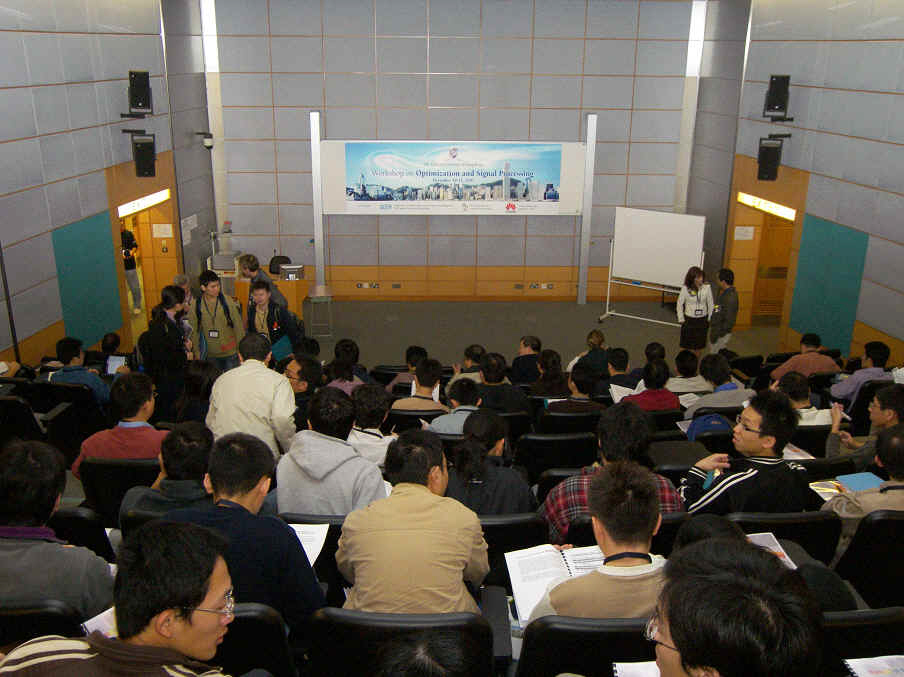
The goal of WOSP2007 was to promote this burgeoning field of interdisciplinary research. This small workshop has attracted 187 registered participants; most of them are graduate students from various universities of Hong Kong. This plus a delegation of 20 technical representatives from Huawei Technologies Ltd located in Shenzhen, as well as many non-registered participants, created a large audience that easily exceeded the maximum seating capacity (245) of the lecture theatre. Some participants had to stand or sat on the floor to listen to the talks. The technical program consisted of tutorial lectures as well as in-depth technical presentations showcasing the success of applications of optimization in signal processing. The lecture materials, including the slides of the presentations, can be found in the website of the workshop:
http://www.se.cuhk.edu.hk/~zhang/WOSP2007/program.html
Some quotes from the participants after the workshop:
“I had known that there was a lot of work going on in optimization and communications; I had not realized it had reached the "tipping point". I was especially happy to see the breadth of work and styles --- ranging from very cool math (majorization, Lyapunov's theorem, asymptotic zero duality gap in nonconvex problems...) to amazing, real applications (in DSP spectrum management, real-time decoding via SDP, ...), and with everything in between, very invigorating!” “Quite seriously, I do think you have now started a tradition …” (Stephen Boyd, Professor of Electrical Engineering, Stanford University)
“Thank you for organizing such a wonderful workshop. It is one of the best technical meetings I have ever attended. The workshop has built a bridge between the optimization theory and its applications in signal processing. It is also a bridge between academic community and the industry, especially Huawei.” (Guozhu Long, Huawei Technologies USA)
Some photos taken during the workshop:
Scenes of the workshop
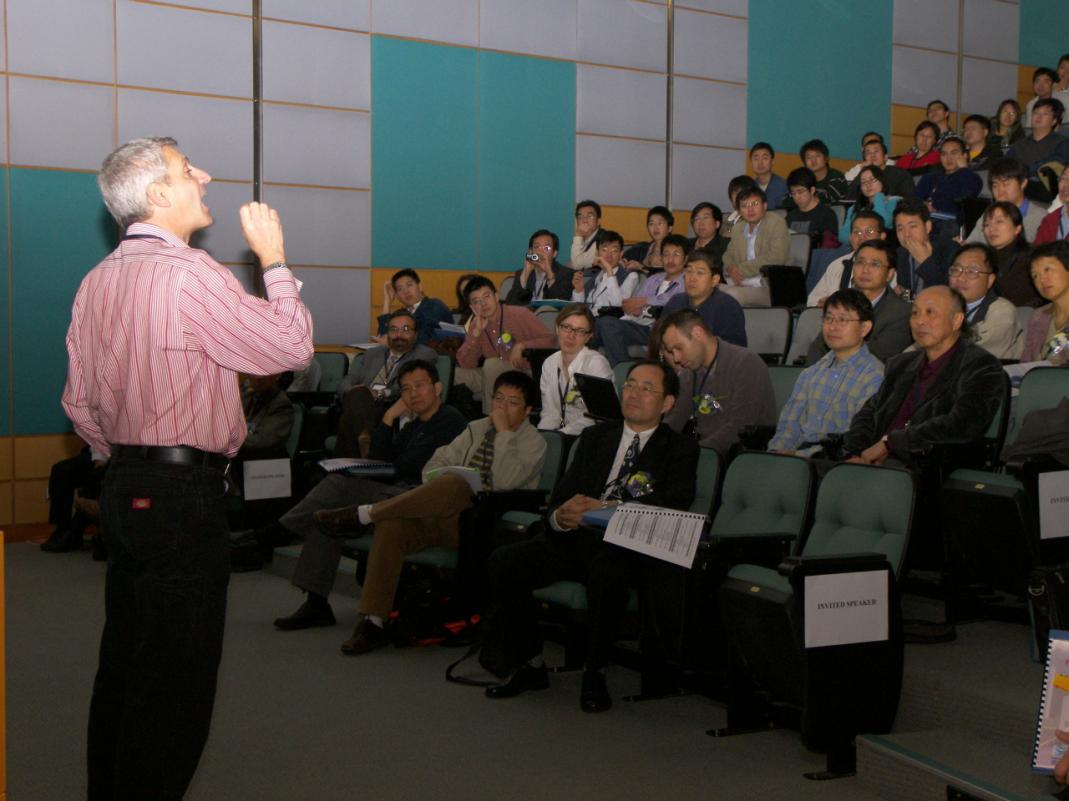
Professor Stephen Boyd delivering his speech on convex optimization